The Model Stopped. The Harness Didn't.
Setup. Same project as the broken MMLU questions: before trusting any benchmark number, check what it is actually measuring. That post was about the data layer. This one is about the harness layer: a one-line bug in lighteval, HuggingFace’s evaluation framework, that made every chain-of-thought generation run to the token cap, wasted up to 95% of the GPU time, and silently corrupted generation-length as a measurement. Reported as lighteval#1278, fix submitted as PR #1279.
The symptom
Running Gemma-4-E2B on MMLU physics with chain-of-thought, every single generation came back “truncated”: tokens_generated exactly equal to the cap, ~145 seconds per item. The obvious diagnosis is a verbose model that needs a bigger budget. So the cap went from 2,048 to 7,168, and the result was… every generation now used exactly 7,168 tokens. A cap you can never out-run is not a capacity problem.
The tell
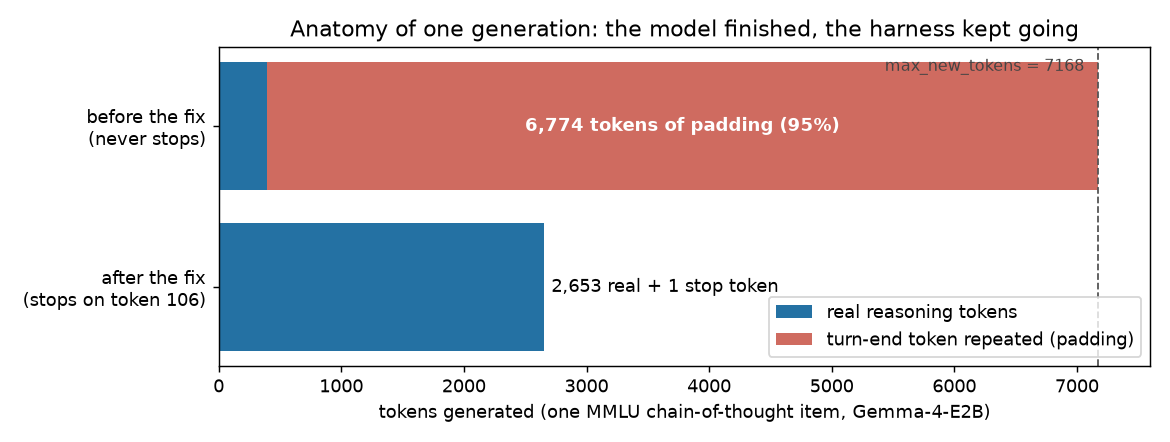
Decoding one raw trace showed what the aggregate hid: the model finished its reasoning in a few hundred to ~2,700 tokens, wrote its answer, emitted its end-of-turn token, and then 63 to 95% of the generation was that same token repeated to the cap. The model had stopped. The harness kept sampling.
The trap: two “fixes” that silently did nothing
The natural repair is a stop sequence. Two attempts, both plausible, both silently ignored:
stop_sequence=["<end_of_turn>"]on the task, because that is what Gemma’s turn terminator is called everywhere in tutorials. In this tokenizer the turn-end token (id 106) does not decode to that string.- The corrected string for token 106. Still padded to the cap.
Both failed for the same reason, visible only in lighteval’s source: for chat models the harness assumes “generation stops with EOS token”, drops task stop sequences, and passes eos_token_id = tokenizer.eos_token_id to generate(), overriding the terminators the model itself declares. Gemma’s tokenizer EOS is token 1; its chat turns end with token 106; its generation_config.eos_token_id correctly declares [1, 106, 50]. The override throws that away, so nothing in the stopping criteria ever matches token 106.
This is a genuinely easy bug to write. The same footgun family (a chat turn terminator that is not the tokenizer’s EOS) has bitten transformers#38182 and unsloth#5386.
The fix: one line
Prefer the model’s declared terminators, fall back to the tokenizer’s:
1
2
3
4
5
eos_token_id=(
    self.model.generation_config.eos_token_id
    if self.model.generation_config.eos_token_id is not None
    else self.tokenizer.eos_token_id
),
Validated on the same item, same GPU:
| before | after | |
|---|---|---|
| tokens_generated | 7,168 (= cap) | 2,654 (stops on its own) |
| padding tokens | 6,774 | 1 |
| latency per item | 145 s | 55 s |
| extracted answer | correct | correct (unchanged) |
At the scale of the planned 488-item run, the before side is pinned by the cap: 488 x 145 s is about 20 hours of GPU time. The after side depends on average trace length; with most items finishing in a few hundred to ~2,700 tokens, the estimate is roughly 3 hours. (Estimate, not yet a measured run: the 55 s item above is one of the longest traces, not the average.)
Why this is worse than wasted GPU time
The wall-clock is the visible cost. The quiet one: tokens_generated stops being a measurement. It tracks the cap, not the model, so any analysis that uses generation length as a signal of reasoning effort is analyzing a constant. And the cap-hits masquerade as model failures: one item in our error pool was “wrong” only because its answer got mangled by the never-stopping decode, and answered correctly the moment the stop worked. If your error analysis includes items a broken harness graded, you are partly studying the harness.
Three lessons, all cheap:
- A config knob that “should” fix it can be silently ignored. Prove a fix with a one-item run; don’t assert it.
- Special tokens are model-specific. Read them from the tokenizer and
generation_config; never hard-code the string you saw in a tutorial. - Read one raw trace before trusting aggregates. Every diagnosis in this story came from looking at actual tokens, not metrics.
A benchmark score is a measurement of a system: model, data, and harness. The data can be broken. The harness can be broken. The number does not tell you which.
The bug report is lighteval#1278; the fix is PR #1279.